
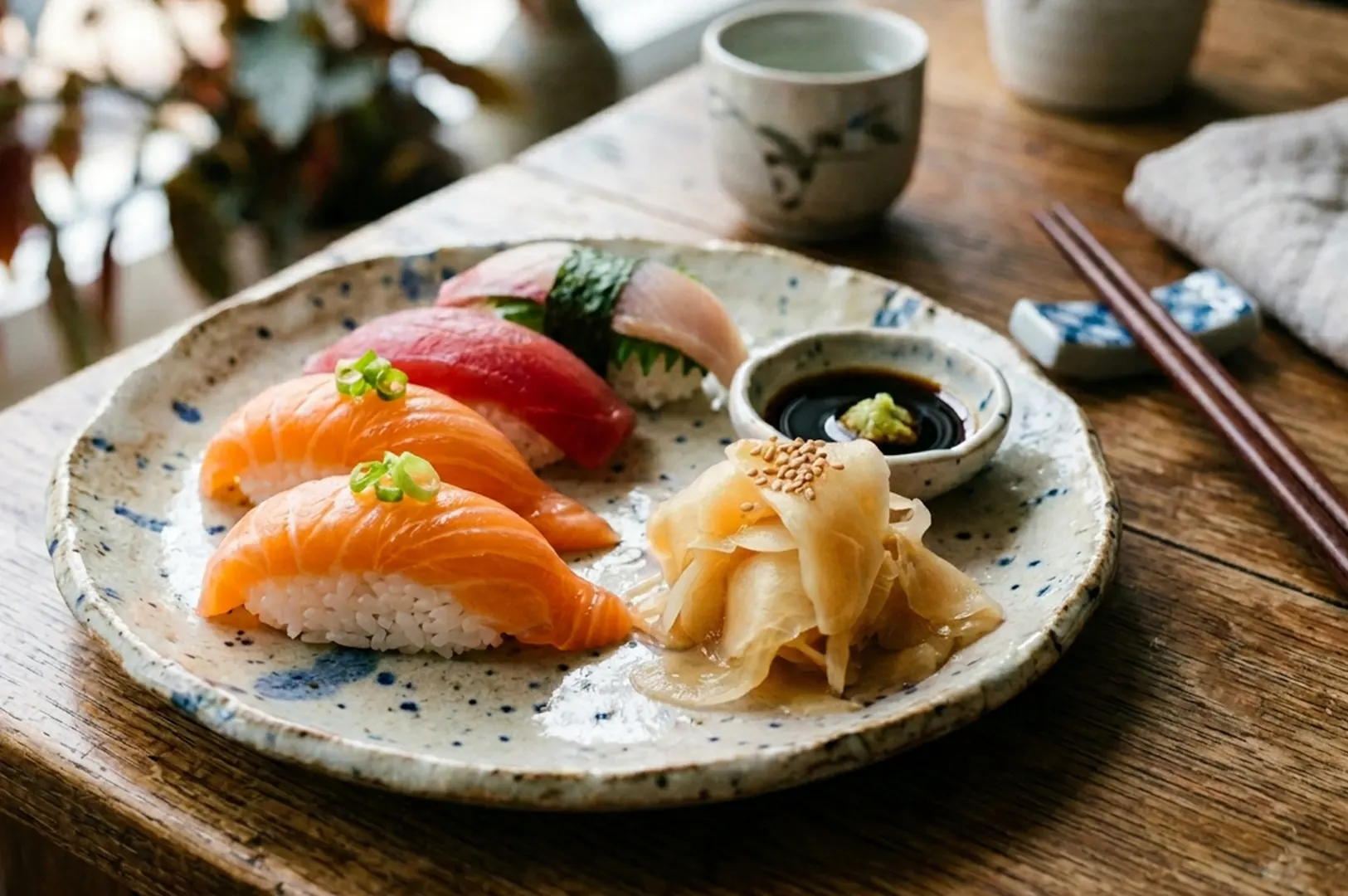
Ginger Between Two Stories
A thin curl of pink ginger rested at the edge of my plate, folded like a petal that had drifted from some unseen tree. The counter light caught its translucent body, soft and glowing, almost luminous. I had not yet reached for it. It simply waited there—quiet and patient—between one bite and the next.
Outside, Singapore carried on with its usual hurry. The afternoon sun pressed against the glass. Cars slid past in long ribbons of light. Somewhere down the street, a kopi machine clattered, and voices rose and fell in the easy music of a city always in motion.
Inside, the world had grown smaller and slower.
We rarely think about the ginger. It sits beside the soy and the wasabi, a humble companion to the fish we truly came for. We chase the marbled tuna, the buttery salmon, the sweet glaze of eel—and the clean, quiet purity of sashimi, served bare so you can taste the sea itself. The ginger waits in the corner, unnoticed, asking for nothing.
Yet it holds a quiet wisdom.
I lifted a single slice and let it rest on my tongue. The first taste was sharp and bright, a clean sting that woke my senses. Then came the sweetness, gentle and cool, softening the fire into something tender. It washed the last flavor away and left a clear, open space behind.
This is the gift of the ginger. It does not belong to the fish before it or the fish that follows. It lives in the pause between them. It is the breath you take between two sentences, the silence that gives meaning to the words on either side.
In a place that moves as quickly as ours, we forget how to pause. We rush from meeting to meeting, from one task to the next, never stopping to clear the space between. Our days blur into a single, unbroken line. But the ginger teaches a different rhythm. It asks you to stop, to reset, to let one moment end fully before the next begins.
There is memory in it too. The sharp scent carried me back to my first sushi meal years ago, to a small counter where an old chef showed me how each piece deserved its own quiet attention. He told me the ginger was not an afterthought. It was a bridge. It carried you gently from one story to the next.
I understood him only now, sitting in this bright corner of Singapore, far from where I began. The ginger had not changed. I had simply learned to listen.
When I placed the next piece of fish on my tongue, it tasted new again, as if I were starting fresh. The ginger had cleared the path. It had given me a small, clean beginning in the middle of an ordinary meal.
We move through life from one story to the next, rarely pausing to mark the space between. Perhaps we could learn from this humble slice of pink. Perhaps we could let ourselves rest in the quiet middle, just for a moment, before turning the page.
The next time you sit at a sushi counter, do not pass over the ginger. Taste it slowly. Let it clear your senses and steady your heart. You may find that the pause holds as much beauty as the meal itself.
Hiroshi Tanaka